logotype
  • Home
  • About Us
  • Projects
  • Careers
  • News & Media
    • News
    • Blogs
    • Events
  • NRI
  • Contact Us
CONTACT US
logotype
  • Home
  • About Us
  • Projects
  • Careers
  • News & Media
    • News
    • Blogs
    • Events
  • NRI
  • Contact Us
logotype
  • Home
  • About Us
  • Projects
  • Careers
  • News & Media
    • News
    • Blogs
    • Events
  • NRI
  • Contact Us
CONTACT US
logotype
  • Home
  • About Us
  • Projects
  • Careers
  • News & Media
    • News
    • Blogs
    • Events
  • NRI
  • Contact Us
  • Home
  • About Us
  • Projects
  • Careers
  • News & Media
    • News
    • Blogs
    • Events
  • NRI
  • Contact Us
Author: pavankumar
HomeArticles Posted by pavankumar
WhatsApp Image 2026-08-11 at 6.51.50 PM (1)
News
August 11, 2026By pavankumar

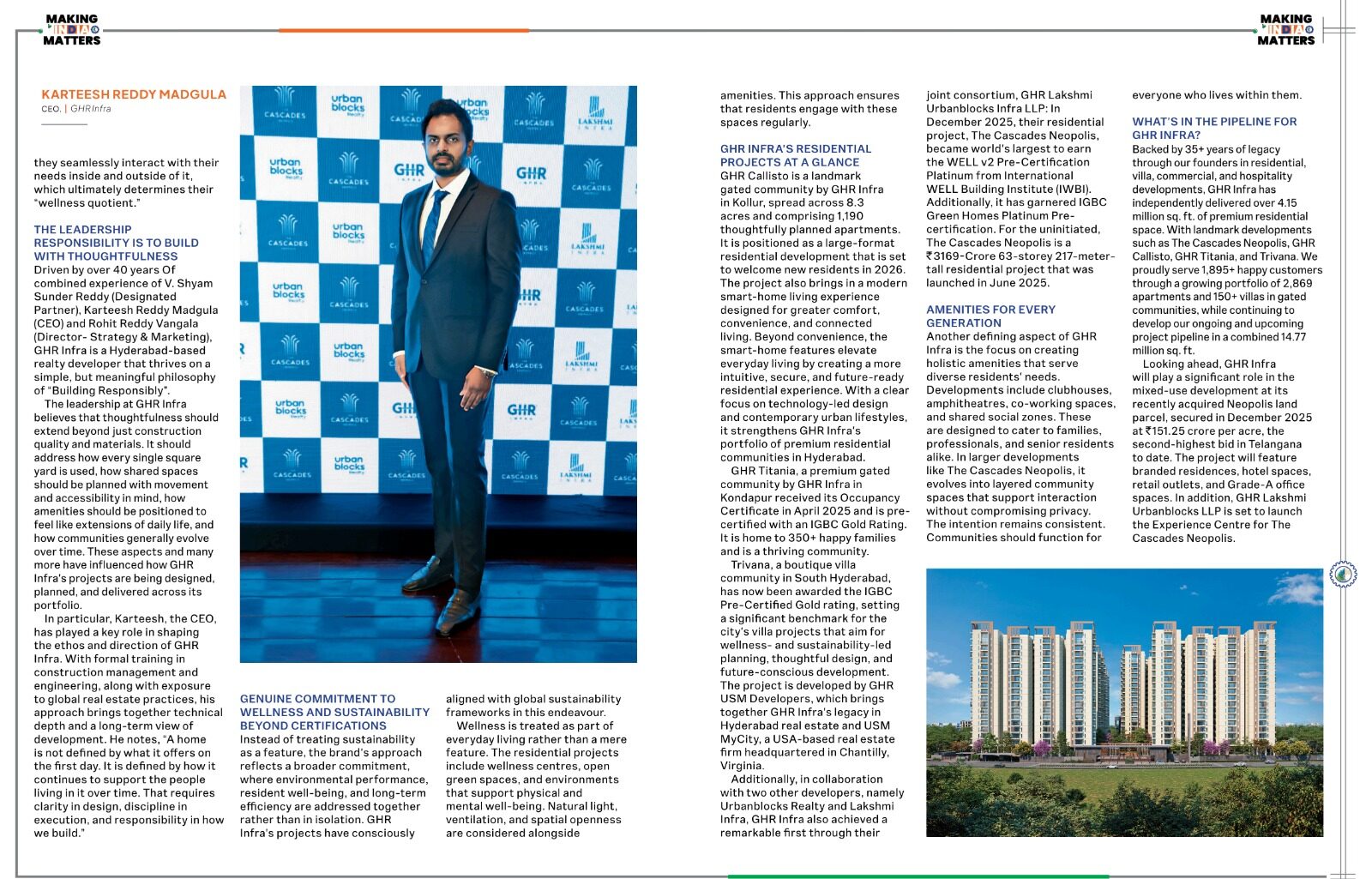
Hyderabad’s transformation, especially over the past two decades or so, has been phenomenal. GHR Infra’s relentless focus on attention to detail has been closely tied to this vibrant city’s growth, as it has now entered a dynamic phase where infrastructure, employment, and residential demand are advancing interdependently.

GHR Infra understands that the role of a developer also needs to adapt and evolve in relation to the city’s residents and growth trajectory. It can no longer be limited to merely constructing buildings with quality material. It is also about shaping how people live within the community and how they seamlessly interact with their needs inside and outside of it, which ultimately determines their “wellness quotient.”

The leadership responsibility is to build with thoughtfulness

Driven by over 40 years of combined experience of V. Shyam Sunder Reddy (Managing Director), Karteesh Reddy Madgula (CEO) and Rohit Reddy Vangala (Director), GHR Infra is a Hyderabad-based realty developer that thrives on a simple, but meaningful philosophy of “Building Responsibly.”

The leadership at GHR Infra believes that thoughtfulness should extend beyond just construction quality and materials. It should address how every single square yard is used, how shared spaces should be planned with movement and accessibility in mind, how amenities should be positioned to feel like extensions of daily life, and how communities generally evolve over time. These aspects and many more have influenced how GHR Infra’s projects are being designed, planned, and delivered across its portfolio.

In particular, Karteesh, the CEO, has played a key role in shaping the ethos and direction of GHR Infra. With formal training in construction management and engineering, along with exposure to global real estate practices, his approach brings together technical depth and a long-term view of development. He notes, “A home is not defined by what it offers on the first day. It is defined by how it continues to support the people living in it over time. That requires clarity in design, discipline in execution, and responsibility in how we build.”

Genuine commitment to wellness and sustainability Beyond Certifications

Instead of treating sustainability as a feature, the brand’s approach reflects a broader commitment, where environmental performance, resident well-being, and long-term efficiency are addressed together rather than in isolation. GHR Infra’s projects have consciously aligned with global sustainability frameworks in this endeavour.

Wellness is treated as part of everyday living rather than a mere feature. The residential projects include wellness centres, open green spaces, and environments that support physical and mental well-being. Natural light, ventilation, and spatial openness are considered alongside amenities. This approach ensures that residents engage with these spaces regularly.

GHR Infra’s residential projects at a glance

GHR Callisto is a landmark gated community by GHR Infra in Kollur, spread across 8.3 acres and comprising 1,190 thoughtfully planned apartments. It is positioned as a large-format residential development that is set to welcome new residents in 2026. The project also brings in a modern smart-home living experience designed for greater comfort, convenience, and connected living. Beyond convenience, the smart-home features elevate everyday living by creating a more intuitive, secure, and future-ready residential experience. With a clear focus on technology-led design and contemporary urban lifestyles, it strengthens GHR Infra’s portfolio of premium residential communities in Hyderabad.

GHR Titania, a premium gated community by GHR Infra in Kondapur received its Occupancy Certificate in April 2025 and is pre-certified with an IGBC Gold Rating. It is home to 350+ happy families and is a thriving community.

Trivana, a boutique villa community in South Hyderabad, has now been awarded the IGBC Pre-Certified Gold rating, setting a significant benchmark for the city’s villa projects that aim for wellness- and sustainability-led planning, thoughtful design, and future-conscious development. The project is developed by GHR USM Developers, which brings together GHR Infra’s legacy in Hyderabad real estate and USM MyCity, a USA-based real estate firm headquartered in Chantilly, Virginia.

Additionally, in collaboration with two other developers, namely Urbanblocks Realty and Lakshmi Infra, GHR Infra also achieved a remarkable first through their joint consortium, GHR Lakshmi Urbanblocks Infra LLP: In December 2025, their residential project, The Cascades Neopolis, became world’s largest to earn the WELL v2 Pre-Certification Platinum from International WELL Building Institute (IWBI). Additionally, it has garnered IGBC Green Homes Platinum Pre-certification. For the uninitiated, The Cascades Neopolis is a ₹3169-Crore 63-storey 217-meter-tall residential project that was launched in June 2025.

Amenities for every generation

Another defining aspect of GHR Infra is the focus on creating holistic amenities that serve diverse residents’ needs. Developments include clubhouses, amphitheatres, co-working spaces, and shared social zones. These are designed to cater to families, professionals, and senior residents alike. In larger developments like The Cascades Neopolis, it evolves into layered community spaces that support interaction without compromising privacy. The intention remains consistent. Communities should function for everyone who lives within them.

What’s in the pipeline for GHR Infra?

Backed by 35+ years of legacy through our founders in residential, villa, commercial, and hospitality developments, GHR Infra has independently delivered over 41.5 lakh sq. ft. of premium residential space. With landmark developments such as The Cascades Neopolis, GHR Callisto, and GHR Titania, Trivana we proudly serve 1,895+ happy customers through a growing portfolio of 2,869 apartments and 150+ villas in gated communities, while continuing to expand our future project pipeline.

Looking ahead, GHR Infra will play a significant role in the mixed-use development at its recently acquired Neopolis land parcel, secured in December 2025 at ₹151.25 crore per acre, the second-highest bid in Telangana to date. The project will feature branded residences, hotel spaces, retail outlets, and Grade-A office spaces. In addition, GHR Lakshmi Urbanblocks LLP is set to launch the Experience Centre for The Cascades Neopolis.

Read More
RootedinResponsibility
Blogs
August 3, 2026By pavankumar

Every year on April 22nd, the world pauses to reflect on its relationship with the planet. Earth Day is a reminder that the choices we make, in how we live, how we build and how we consume, have a lasting impact on the environment we share.
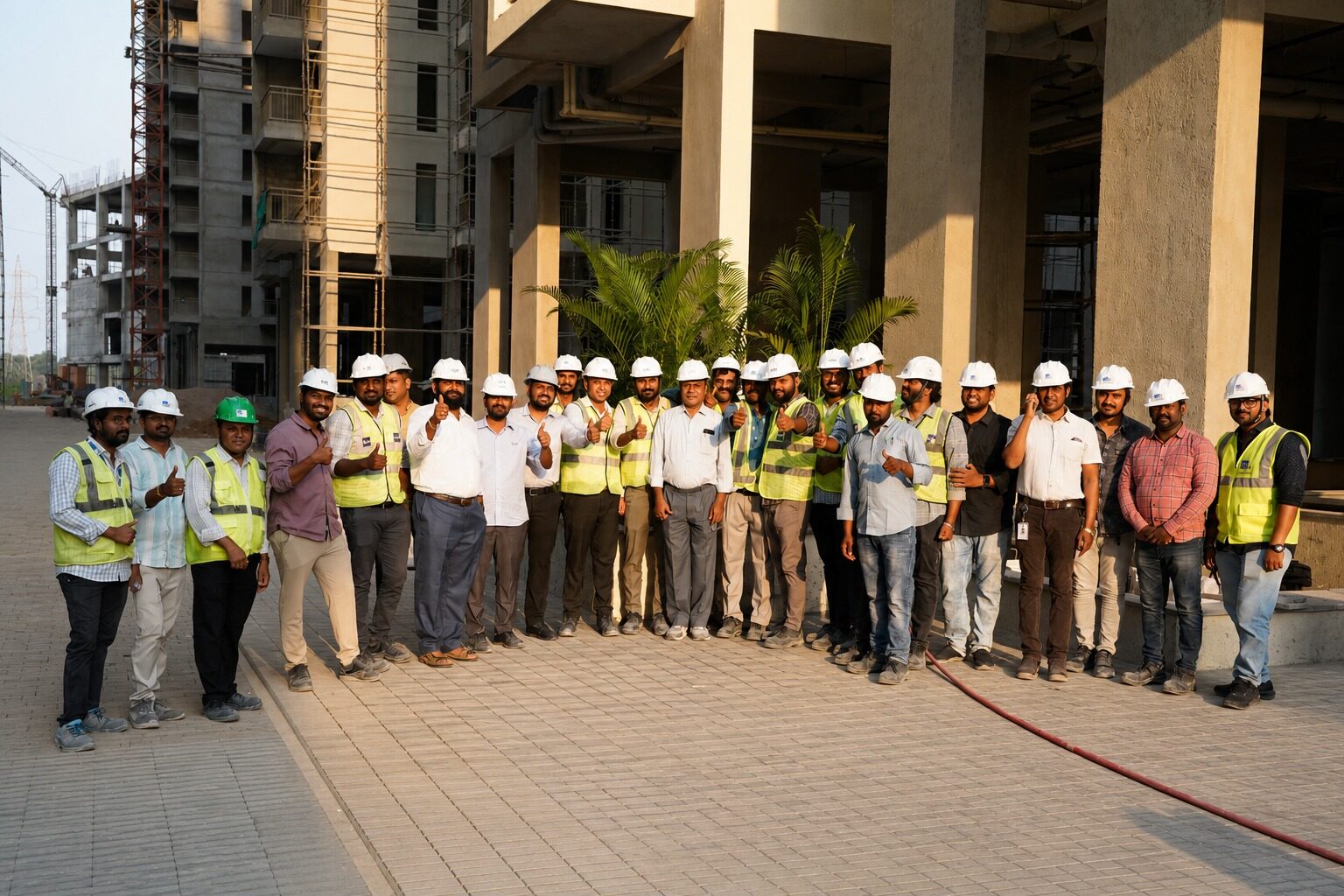
This Earth Day, the GHR Infra team came together at GHR Callisto, Kollur, Tellapur, to mark the occasion with something simple and meaningful. A tree planting initiative, where members of the team rolled up their sleeves, dug into the soil and planted saplings across the community grounds.
It was a small act. But for GHR Infra, it reflected something deeply embedded in the way the company operates.

BUILDING RESPONSIBLY IS NOT A PHRASE. IT IS A PRACTICE.
At GHR Infra, sustainability is not a feature applied at the end of a project. It is a decision made at every stage of design, material selection, construction and delivery. Across the GHR portfolio, every development is built to certified green building standards.
GHR Callisto holds an IGBC Pre-Certified Gold rating, designed around water conservation, energy efficiency, native vegetation and responsible materials. With over 70% open space across 8.3 acres, the community was always conceived as a place where nature and smart living coexist.
GHR Trivana, the boutique villa community in South Hyderabad, holds an IGBC Pre-Certified Gold rating and is designed to reduce water consumption by 37%, harvest 100% of rainwater on site and run on GreenPro-certified materials for 53% of its total build.
The Cascades Neopolis, GHR Infra’s flagship development in Kokapet, is India’s first and the world’s largest WELL v2 Pre-Certified residential project. Designed to deliver 42% water savings, 30% reduction in annual energy use and 95% recycling of construction debris, it represents the highest global standard for health and wellness in the built environment.

A TREE PLANTED. A PROMISE RENEWED.
The saplings planted at GHR Callisto on Earth Day 2026 will grow alongside the community. They are a quiet, living reminder of what GHR Infra stands for. That every project begins with a responsibility to the earth it stands on, and that building responsibly means caring for that earth long before and long after the last brick is laid.
GHR Infra. Building Responsibly. Building Hyderabad.

Read More
Property_Buying_Tips_for_Hyderabad_Home_Buyers_in_2026
News
August 3, 2026By pavankumar
For homebuyers in 2026, the approach to purchasing a home in Hyderabad should shift from general considerations to more strategic and portfolio-based thinking. While the city’s residential market continues to show resilience, with steady price growth and new infrastructure developments, the combination of rising prices, meaningful interest rates, and attractive policy incentives means that how you buy is just as important as what you buy.

In an environment where pricing has seen a notable run-up and interest rates remain a significant consideration, the strategies you employ today will determine the long-term benefits of your investment. A smart purchase is no longer about spotting a popular neighbourhood and moving quickly. It is about understanding why certain markets are gaining value, how that value connects to jobs and infrastructure, and whether your financing plan can support the decision over the long term.

Here are the key points that Hyderabad’s serious homebuyers should consider planning around as they navigate the market in 2026 and beyond:

Start with ticket size, then study the micro-market

The first strategy is simple, and many buyers still get it wrong. Start with the budget you can sustain, then choose the micro-market that fits it. Across Hyderabad, active residential markets are already operating in a broad band of roughly ₹7,000 to ₹12,000 per square foot, and premium pockets have moved much higher. Neopolis, Kokapet, and Financial District have all seen upward movement because they sit inside or next to the city’s strongest office-led growth belt. In Q1 2026, Neopolis was benchmarked at roughly ₹11,500 to ₹15,500 per square foot, Kokapet at ₹9,500 to ₹12,500, and Financial District at ₹8,500 to ₹11,000.

This matters because buyers often approach these locations through aspiration first and affordability later. That sequence can create financial stress very quickly. A better approach is to decide whether your budget belongs in a mature premium corridor, an emerging growth corridor, or a longer-horizon value corridor. The reason is straightforward. Price growth follows economic density, and economic density differs sharply from one pocket to another.

West Hyderabad is here to stay

Financial District, Kokapet, and Neopolis continue to attract stronger pricing, because they are tied to the city’s most powerful employment catchment. Financial District functions as a core commercial and IT hub. That concentration of work creates steady housing demand from professionals, senior executives, and investors looking for a location that remains useful every day. Once a market serves a strong employment base, residential demand becomes deeper and more durable.

Kokapet benefits from this same logic. It converts access to the western office belt into premium residential demand. Better roads, stronger social infrastructure, and the area’s rise as a premium corridor have all pushed its relevance upward. Neopolis adds planned scale, stronger branding, and a concentration of Grade A developers. That combination matters because large developers usually commit where long-term demand looks credible. Their presence lifts buyer confidence. Buyer confidence supports higher launches. Higher launches strengthen the area’s premium identity.

South Hyderabad deserves our attention too

South Hyderabad deserves more serious attention in 2026 and beyond, especially for buyers who want a different balance between entry price and future upside. Airports tend to reshape nearby land economics over time, and Hyderabad is no exception. Tukkuguda, Adibatla, Maheshwaram, Pharma City, 4th City Growth Corridor, and Shamshabad attract logistics, hospitality, travel-linked commerce, and supporting development. Once this ecosystem expands, residential demand often follows.

South Hyderabad does not need to mirror Financial District to become relevant. Its case is different. It is stronger for buyers who want to enter before price discovery becomes too aggressive, and for those who are comfortable holding through an infrastructure-led growth cycle. A buyer priced out of Kokapet or Neopolis may find a more practical entry in the southern belt, provided the location has clear access advantages and visible development direction. The strategy here is patience. These are not markets to judge only on current social profile. These are markets to study through future mobility, airport access, and land-use evolution.

Choose product and location together

The next strategy is to align the product with your finances and your purpose. This sounds obvious, yet it is often ignored. Hyderabad still offers more flexibility than several other major metros, which means buyers can sometimes choose a larger home or a better amenity package without pushing monthly outgo too far. That flexibility should be used carefully.

For an end-user, the right choice may be a well-connected project in an emerging corridor where daily life remains manageable and future growth remains believable. For a long-horizon investor, infrastructure and job catchments can alter value over time. The strategy is to ask one question early: am I buying for immediate lifestyle, medium-term appreciation, or long-term asset creation? Your answer should shape where you buy and what you buy.

Optimise the home loan with the same care as the home

A buyer who studies location carefully and ignores financing can still make a weak decision. Loan structure matters because affordability is shaped over years, not at the moment of booking. One practical benchmark in the strategy note is to keep EMI below 30 to 35 per cent of take-home salary. This gives the buyer room to absorb future rate movement and everyday household expenses without strain.

The note also points to periodic part-prepayments using bonuses, RSUs, or incentives. This is a useful strategy, because early prepayments reduce tenure and interest burden more effectively than leaving that cash in a low-yield instrument. Fixed or part-fixed loan structures also deserve attention for buyers who value payment stability during the first several years. The point here is not to find the lowest EMI on day one. The point is to build a loan plan that remains comfortable through the full cycle of ownership.

Think beyond momentum

One more strategy deserves equal importance. Study the friction in a market, not only the upside. A buyer who understands both the growth driver and the risk driver makes a far stronger decision. If future appreciation depends on infrastructure completion, ask how much of that infrastructure is already visible. If a low launch price seems unusually attractive, ask whether approvals are fully in place. If a corridor is gaining attention because of office growth, ask whether your own timeline matches that growth cycle.

The strongest buyers in Hyderabad over the next few years will be the ones who think like allocators of capital, not followers of momentum. The strategy is not to chase every hot market. The strategy is to match your finances, your timeline, and your risk appetite to the part of Hyderabad that makes the most sense for your life.

About GHR Infra:

GHR Infra is a leading real estate group backed by founders with a proven track record of over 30 years in creating exceptional properties. The company has established itself as a pioneer in developing high-quality, innovative, and sustainable residential projects. With a commitment to excellence, GHR Infra continues to set new benchmarks in real estate, crafting homes that meet the evolving needs of modern living. For more information, visit GHR Infra

Author Profile: Mr. Karteesh Reddy Madugula, CEO, GHR Infra 

Mr. Karteesh Reddy Madugula is an accomplished real estate and hospitality leader with a proven track record of developing landmark projects that redefine urban living and elevate hospitality experiences. With over 17 years of diversified experience spanning hospitality, healthcare, and real estate, he brings a strong blend of technical expertise, strategic acumen, and visionary leadership to every venture he leads.

An alumnus of the prestigious University of Southern California, Los Angeles, Karteesh combines global exposure with deep industry insight, enabling him to conceptualize and execute large-scale, design-led, and future-ready developments.

Commitment to Transformative Development

Throughout his career, Karteesh has built a versatile portfolio that includes 3-star business hotels, convention centers, gated villa communities, and ultra-luxury high-rise developments. His projects are known for combining thoughtful design, sustainability, cutting-edge technology, and customer-centric planning.

At GHR Infra, he is currently spearheading:

  • The development of Hyderabad’s tallest and most iconic residential towers, setting new benchmarks in city architecture.
  • The transformation of hospitality assets through strategic acquisitions and repositioning.

The integration of AI-driven innovations, automation systems, and smart community platforms to enhance quality of life and operational efficiency.

Source :
https://therealtytoday.com/news/expert-opinion/key-strategies-that-home-buyers-in-hyderabad-should-consider-in-2026-and-beyond/

Read More
original_image_27
News
July 31, 2026By pavankumar

Hyderabad, Jul 27, 2026: For Suparna Shree, moving from Dhanbad to Delhi began with her studies. Housing, however, soon became one of the biggest pressures on her finances, influencing not only how much she could save but also how she evaluated employment opportunities.

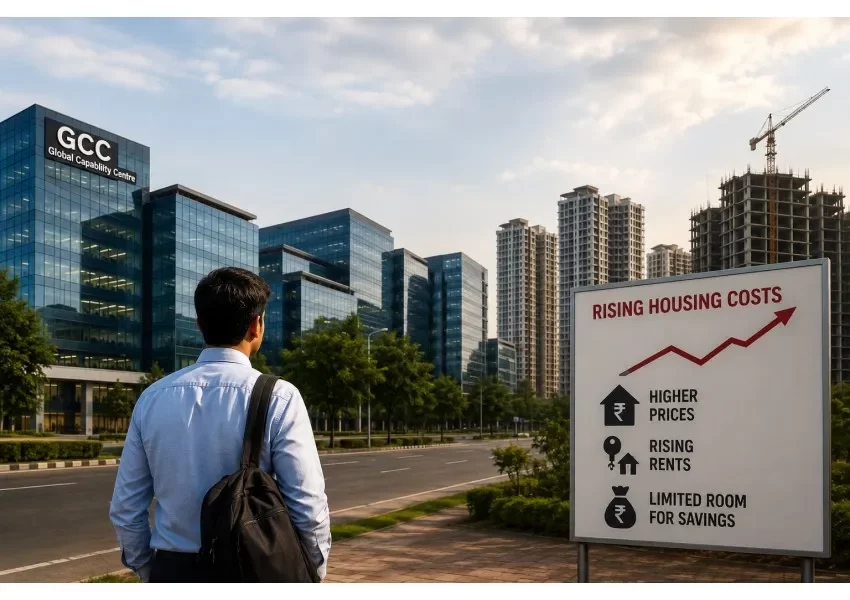
Around 45 per cent of her monthly income goes towards rent, another 16 per cent towards commuting and about 9 per cent towards electricity. Together, these expenses account for nearly 71 per cent of her income, leaving limited room for savings and discretionary spending.

The pressure has also entered her professional decisions. Suparna says she considers the House Rent Allowance offered by an organisation before accepting a job and has previously changed jobs after annual rent increases made her budget difficult to manage. “I have changed jobs because my landlord increased the rent every year, making it difficult to manage my budget,” she says.

Her experience is interestingly a marker for a wider challenge facing India’s rapidly expanding Global Capability Centre (GCC) ecosystem. As employment clusters grow and attract professionals from across the country, demand for homes and rentals around workplaces rises with them. But where land and development costs increase, supplying homes at prices accessible to middle-income workers becomes harder.

India’s GCC ecosystem has crossed 2,117 centres, employing around 2.36 million professionals. GCCs account for nearly 40 per cent of India’s office demand, according to industry responses, giving their expansion an increasingly important role in shaping not only commercial districts but also the residential markets developing around them.

Jobs Grow, Housing Economics Change

Nandakumar O.P., COO – Commercial, Brigade Group, sees a clear correlation between the rapid expansion of GCCs and changing housing dynamics in Bengaluru and Hyderabad. “The influx of high-skilled professionals has driven demand for both ownership and rental housing, contributing to rising land and home prices,” he says.

The challenge begins with what happens to land around expanding employment corridors. As demand for offices, homes and supporting infrastructure increases, land values can rise, adding to project costs. Developers then have to make projects viable on more expensive land, making lower-ticket housing increasingly difficult to deliver.

This pressure comes as the residential market has already moved towards higher ticket sizes. According to Manoj Dhanotiya, Founder and CEO, Micro Mitti, 78 per cent of homes sold nationally now cost above Rs 1 crore. He says residential prices rose 13-15 per cent in Bengaluru and 8-13 per cent in Hyderabad last year. “Housing always chases jobs,” Dhanotiya says.

The problem, however, is not simply that premium homes are being built. India’s GCC workforce includes senior professionals alongside a large pool of young and mid-level salaried employees whose housing budgets do not necessarily rise at the same pace as land and property prices.

Karteesh Reddy Madgula, CEO, GHR Infra, says GCC growth creates salaried demand, improves absorption and supports rental yields and investor confidence. But that growth can create an imbalance if residential supply becomes concentrated at the upper end. “The risk begins when supply chases only premium demand and leaves mid-income housing behind,” he says.

For developers, this creates a difficult equation. Demand for moderately priced housing can remain strong, but rising land costs, approval expenses and other development costs can make such projects increasingly challenging to execute near employment centres.

When A Housing Challenge Becomes A Talent Challenge

For employees, the impact appears in rent, commute, savings and the choice of where to live. Anushka, who moved from Delhi to Hyderabad for work, says finding suitable accommodation took considerable time. Rent, maintenance, the initial security deposit and commuting expenses have reduced her ability to save, while staying within budget meant compromising on the type of accommodation she wanted. “Housing affordability plays a major role in career decisions. It is something I would definitely consider before relocating again in the future,” she says.

For Khushi, who moved from Odisha to Bengaluru, the trade-off was different. Budget and proximity to her workplace were key considerations, along with finding a fully furnished apartment. She eventually gave up the convenience of living within walking distance of her office to find accommodation that worked for her. Homeownership is not an immediate option either. “The biggest hurdle is definitely money, and I would say flexibility too. Buying a home would tie you down to a place and I’m not sure if I’m ready for that,” she says.

These experiences turn the housing debate into more than a real estate question. If employees increasingly have to choose between high housing costs and longer commutes, housing can begin to influence labour mobility and the ability of employment centres to retain workers.

“Talent sustainability depends on liveability, not salaries alone. A city cannot retain its workforce if employees spend too much time or income on housing,” Madgula says.

Can Rental Housing Bridge The Gap?

For a mobile workforce, the immediate solution may not always be homeownership. A significant section of professionals relocating for jobs rents before deciding whether to settle permanently in a city, making rental supply an important part of the GCC-housing equation.

Dhanotiya says rental increases have moderated from 12-24 per cent during 2021-24 to around 7-9 per cent now. But he argues that slower rental inflation does not resolve the underlying issue. “The real problem isn’t the rate, it’s the shortage of decent mid-income rentals near workplaces,” he says.

Industry executives see organised rental housing as one possible response. Nandakumar expects demand for professionally managed rental communities to increase as the GCC workforce, already at 2.36 million, continues to expand. He points to institutional rental housing, co-living and long-term rental frameworks as formats that could broaden supply for workers who are unwilling or unable to buy.

Madgula similarly expects managed rentals, co-living and build-to-rent formats to gain relevance over the next five years. But adding rental stock alone may not be sufficient if workers still have to live far from employment centres. “The key need is predictable supply near workplaces, stronger tenant-owner frameworks, better last-mile transport and rental housing planned as part of employment districts, not treated as an afterthought,” he says.

That approach shifts the solution from building more homes alone to planning jobs, housing and transport together.

Making Mid-Income Housing Viable Again

Developers argue that correcting the ownership market requires addressing the economics that make lower-ticket projects difficult to deliver. Nandakumar attributes the declining presence of affordable housing in Tier-I cities to rising land costs, regulatory cost burdens and insufficient incentives. His proposed response includes releasing public land specifically for lower-cost housing, faster single-window clearances and stronger floor space index incentives.

The objective, according to the industry view, is to reduce the cost pressure on projects rather than expecting developers to absorb increasingly expensive land while keeping selling prices low.

Dhanotiya proposes another approach: connect the incentives governments offer to GCC investments with housing obligations. “Tie GCC land subsidies to an affordable-housing quota. Give the incentive, but attach a condition,” he says.

Such proposals would require government, developers and businesses to treat housing supply as part of economic planning rather than allowing residential development to follow employment growth after land prices have already risen.

For Madgula, the focus should also remain on mid-income supply, transit and employee catchments. GCCs need not become housing providers, he says, but can participate in city-level discussions about the infrastructure required by their workforce.

Tier-II Cities Have A Window To Act

The strongest opportunity to test these solutions may lie outside established metros. More than 375 GCC units are already operating across emerging cities, according to Nandakumar. Kochi, Coimbatore and Mysuru are among the markets seeing expansion, while Dhanotiya points to corporate activity in Indore, Nagpur, Vadodara and Jaipur.

These cities still have an advantage: land and office costs remain relatively lower. Dhanotiya says Tier-II office lease rates are 30-50 per cent cheaper than Bengaluru. But early signs of appreciation are already visible. Indore’s guideline rates rose around 26 per cent in 2025, while values along its Super Corridor have increased by more than 35 per cent over five years, he says. If employment expands faster than housing supply, however, the cost advantage could narrow.

Madgula warns that early land speculation, premium-led launches and inadequate public transport can push local and middle-income workers farther from new employment hubs. His prescription is to map employment growth with housing supply, reserve land for mid-income projects, improve approval timelines and build transport before prices harden. “The mistake would be waiting until affordability becomes a crisis,” he says.

That makes Tier-II expansion both a warning and an opportunity. Bengaluru and Hyderabad show what can happen when strong employment growth collides with rising land values and a housing market moving towards higher ticket sizes. Emerging GCC cities still have the chance to integrate workplaces, rental housing, mid-income homes and transport before those pressures become entrenched.

For Suparna, the consequences of that imbalance are already visible: above 70 per cent of her income goes towards rent, electricity and commuting, while buying a home remains distant. The next phase of India’s GCC growth will therefore depend not only on how many jobs cities attract, but also on whether housing and infrastructure planning can ensure the people taking those jobs can afford to live within reach of them.

Source Link : https://www.businessworld.in/article/limited-room-for-savings-gcc-expansion-raises-housing-challenge-for-india-s-salaried-workforc-616654


Ginger is not active here 😥
Please reload your page to activate your extension.

Read More

let`s talk

let`s talk
X-twitterFacebook-fInstagramLinkedinYoutube
logotype

Contact

GHR INFRA | Corporate Office
Address:
12th Floor, Vamsiram Jyothi Optima, Sy. No. 158, Opp. Rockwell International School, Narsingi, Gandipet, Hyderabad, Telangana 500075.

Email: Info@ghrinfra.in

Phone: 70280 45222

Working Hours

Mon – Sun: 10am – 6pm

Quick Links

Privacy Policy

Copyright © 2026 . All Rights Reserved